⛽
Targets Better Fuel Economy
The OBD Fuel Saver plugs into your car's OBD2 port and adapts the engine's driving map over roughly 200 km, aiming to trim unnecessary fuel consumption on everyday trips.
Independent Review · 2026
The OBD Fuel Saver is a compact chip tuning box that plugs straight into your car's OBD2 port and learns your driving style to help reduce wasted fuel. Here is what it does, what buyers actually report, and whether it deserves a place in your glovebox.
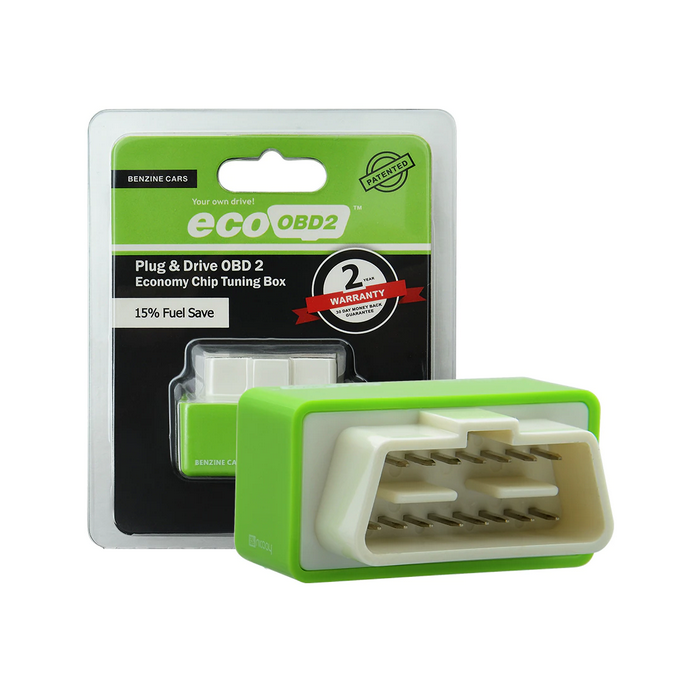
The OBD Fuel Saver plugs into your car's OBD2 port and adapts the engine's driving map over roughly 200 km, aiming to trim unnecessary fuel consumption on everyday trips.
No workshop, no wiring, no tools. Find the OBD2 socket under the dashboard, push the box in, turn the ignition and let it learn your driving style.
Designed for petrol (benzine) cars built from around 1996 onward that use a standard 16-pin OBD2 diagnostic port.
Many owners report the biggest noticeable change is throttle feel and steadier acceleration rather than a dramatic power jump.
Unplug the box and your car returns to its factory behaviour, which is why cautious drivers are willing to test it at all.
The retail pack advertises a 2-year warranty plus a 30-day money-back guarantee, so a disappointing result is not a dead loss.
Hands-on style review · Updated 2026 · ~6 min read
Fuel is one of the few car costs you feel every single week, so it is no surprise that a small green box promising a double-digit saving grabs attention. The OBD Fuel Saver — sold as a "Plug & Drive OBD 2 Economy Chip Tuning Box" — claims to optimise your engine's fuel map through the diagnostic port that every modern car already has. In this OBD Fuel Saver review we look at how it works, what results are realistic, and who should actually buy one.
It is a palm-sized module that slots into the 16-pin OBD2 socket found under the dashboard of virtually every petrol car built since the late 1990s. Traditional chip tuning means remapping the ECU on a bench or with a professional tool. This device takes the consumer-friendly route: no cutting, no soldering, no garage visit. You push it in, turn on the ignition, and drive.
The manufacturer describes a learning phase of roughly 200 kilometres. During that window the unit monitors how you drive — throttle inputs, cruising speeds, gear behaviour — and gradually settles on a profile intended to reduce unnecessary fuel burn. Because the adaptation is progressive, day-one impressions are meaningless. Any honest OBD Fuel Saver review has to be based on several full tanks measured the old fashioned way: fill up, reset the trip meter, drive, fill up again, divide.
This is the part nobody disputes. Locate the OBD2 port (usually beneath the steering column, sometimes behind a small flap), push the connector home until it clicks, and you are done. There is no app to configure and no subscription. Removing it is just as quick, and the car reverts to standard behaviour immediately — a big reason the device feels low-risk compared with a permanent remap.
Buyer feedback clusters into three groups. The largest group reports a modest improvement — a slightly longer range per tank and a throttle that feels more responsive, especially at steady motorway speeds. A second group notices little or no measurable difference, most often in heavy stop-start city driving where idling and braking dominate consumption. A smaller group reports a strong improvement, though these results usually coincide with other changes such as gentler acceleration, correct tyre pressures or a recent service.
Marketing figures such as "15% fuel save" are best treated as a ceiling under ideal conditions, not a promise. Physics still applies: the single biggest lever on fuel consumption is your right foot, followed by tyre pressure, weight, air conditioning use and route choice. Think of the OBD Fuel Saver as a nudge that supports better habits rather than a device that rewrites the laws of combustion.
Record your baseline first: three consecutive full tanks with your normal routes, so you have a real litres-per-100 km figure. Fit the device, drive at least 200 km, then measure three more tanks the same way. Keep the packaging and receipt during the 30-day window. If the numbers do not move, you have documented proof for a refund claim — and you have learned your true baseline consumption either way.
The OBD Fuel Saver is not a miracle device, and anyone promising guaranteed double-digit savings is overselling it. What it is: a cheap, reversible, effortless accessory that some drivers find delivers a small but real improvement in economy and throttle feel. Because it costs little, installs in seconds and is covered by a money-back guarantee, the downside of trying it is limited to your time. If you drive a petrol car with regular motorway mileage and you are willing to measure results honestly, it is a reasonable experiment. If you expect it to offset a heavy right foot or a poorly maintained engine, it will disappoint.
"Installed it in five seconds on my 2013 hatchback. After the learning period my average consumption on the commute dropped noticeably. Throttle feels crisper too."
"I was sceptical, but for the price it was worth testing. Small improvement on motorway runs, not much difference in stop-start city traffic."
"Simple, no wiring, no risk. If you don't like it you just pull it out. That's what convinced me to try one."
"Best results came after I also fixed my tyre pressure and driving habits. Treat it as one part of saving fuel, not magic."
Most instructions ask for around 200 km of mixed driving while the unit adapts. Judge results by comparing several full tanks before and after, not a single trip computer reading.
The device reads and interacts through the standard OBD2 diagnostic port and can be removed at any time. If your car is still under manufacturer warranty, check the terms before fitting any third-party OBD accessory.
Petrol cars with a standard 16-pin OBD2 socket, typically from 1996 onward. Diesel-specific versions are sold separately.
For a low one-off price with a money-back window, it is a low-risk experiment. Expect modest, gradual savings rather than the headline percentages in the marketing.
Plug it in, drive normally, and let the box do the learning — backed by a 30-day money-back guarantee.
Buy Now Limited Time Offer